


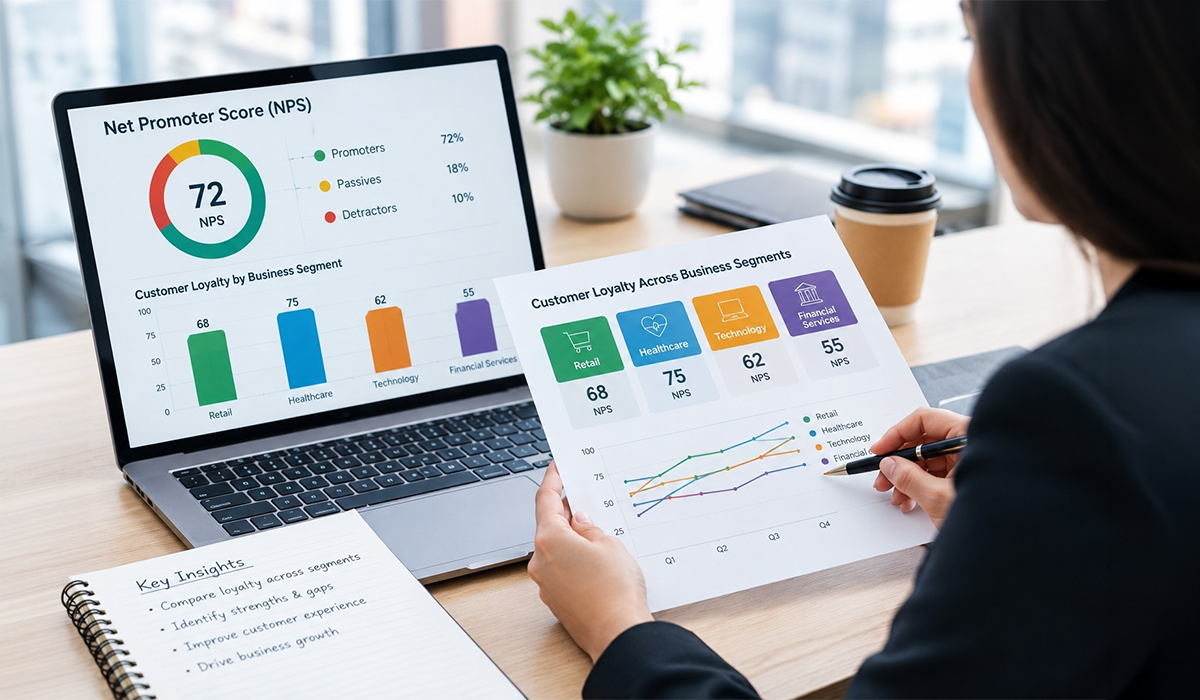
Net Promoter Survey research gives businesses a structured way to understand how willing people are to recommend a company, product or service. Comparing responses across carefully defined groups can reveal differences that an overall result may conceal. This makes the approach useful for organisations seeking evidence about loyalty and changing customer expectations.
Customer loyalty is rarely uniform across an entire customer base. Different groups can have different purchasing patterns, service requirements, relationship lengths and reasons for remaining with a provider. A market research approach can separate these differences and help decision-makers identify areas that deserve closer investigation.
Why Segment-Level Research Creates Better Insight
A single loyalty figure can provide a useful headline, but it cannot explain how different groups experience a business. Established customers may have stronger relationships than recent customers, while service users may have different expectations from product buyers. Comparing these groups can show whether positive perceptions are broad or concentrated.
A Net Promoter Score survey can retain the same core measurement while adding relevant segmentation variables. This creates a consistent basis for comparison and helps researchers examine whether advocacy varies according to customer characteristics. Each segment should have a clear research purpose rather than being created simply to produce more data.
Useful variables may include:
- Relationship length and customer tenure
- Product or service category
- Purchase frequency
- Customer type or business size
- Engagement with selected services
Sample size also matters because very small groups can produce unstable findings. Researchers should establish the purpose of each segment before fieldwork and ensure that comparisons can support reasonable interpretation.
Net Promoter Survey: Comparing Loyalty Across Business Segments
Net Promoter Survey findings become more valuable when researchers investigate why one group differs from another. A stronger result in one segment does not necessarily mean that the same experience is creating advocacy elsewhere. Research should connect numerical differences with the circumstances surrounding each group.
NPS customer segmentation provides a practical framework for making these comparisons. Respondents can be grouped according to characteristics relevant to the research question while the core measurement remains consistent. This helps identify whether loyalty is broad-based or particularly strong within selected groups.
A segmented comparison might examine:
- New customers against long-standing customers
- Frequent users against occasional users
- Different product or service categories
- Business customers with different operating profiles
- Groups with different engagement levels
The purpose is not to label one segment as good and another as poor. A lower result may reflect higher expectations, a different service journey or a specific operational issue. Researchers should consider these factors before recommending a response.
Understanding the Reasons Behind Different Results
Customer loyalty research can move the study beyond a numerical score by examining experiences and expectations associated with each segment. Respondents may value reliability, communication, responsiveness, convenience or product performance in different proportions. Identifying these priorities can show what appears to strengthen or weaken relationships.
Open-ended questions are particularly useful because respondents can explain their rating in their own words. Researchers can compare recurring themes between groups without assuming that every customer has identical priorities. This qualitative layer can prevent businesses from drawing conclusions from scores alone.
The analysis may focus on:
- Reasons behind positive recommendations
- Common concerns among less positive respondents
- Experiences associated with stronger advocacy
- Expectations that differ between groups
- Issues requiring further investigation
Two segments may produce similar results while describing completely different experiences. Understanding that distinction can make the resulting recommendations more relevant.
Creating a Reliable Basis for Comparison
NPS benchmarking can help organisations understand whether a result is improving, declining or remaining stable. Internal comparisons are particularly useful because the same organisation can apply consistent questions and segmentation methods over different research periods. This makes changes easier to identify.
External benchmarks require greater caution. Differences in sample composition, question wording, industry conditions and methodology can affect results. A direct comparison may therefore be misleading when the populations are not genuinely comparable.
For organisations operating in the UAE, consistency in research design can make longitudinal analysis more meaningful. Comparable sampling principles, survey structures and reporting methods help businesses distinguish genuine changes from methodological differences.
Turning Feedback Into Actionable Findings
NPS data analysis should connect the measured result with the evidence surrounding it. Researchers can examine scores alongside segment characteristics and written comments to identify patterns that require attention. This can help management understand where an issue is concentrated instead of assuming that it affects everyone.
For example, one group may repeatedly mention response times while another focuses on product reliability. Both issues can influence loyalty, but they may require different operational responses. A segmented analysis can therefore help businesses prioritise action according to evidence.
A useful reporting structure can include:
- Key differences between customer groups
- Changes since the previous study
- Repeated themes in open responses
- Possible drivers of stronger or weaker advocacy
- Questions requiring further research
The final report should explain findings in clear business language. Decision-makers should understand what changed, which groups are affected and what evidence supports the recommended next step.
Using Research to Refine Customer Experience Decisions
Customer feedback analysis can help organisations determine whether an issue is isolated or widespread. A concern appearing mainly within one segment may require a targeted response, while an issue repeated across several groups could indicate a broader experience problem. This distinction can prevent resources being directed towards changes that do not address the actual source of dissatisfaction.
Research can also identify positive practices worth examining. If one segment reports particularly strong experiences, researchers can explore what is different about its journey and whether relevant practices could be applied elsewhere. This turns loyalty measurement into a source of learning rather than simply a performance score.
Recommendations may support communication, service processes, retention activity, product development or future research. They should remain connected to evidence rather than assumptions.
The Role of Professional Research Support
A market research service in UAE can help organisations build a study around clear objectives, suitable sampling and meaningful segmentation. Professional researchers can support questionnaire development, fieldwork, data interpretation and reporting while keeping the research question central. This is valuable when a customer base contains several distinct commercial groups.
A market research company in UAE can also help businesses avoid common interpretation problems, such as comparing groups with insufficient responses or treating correlation as proof of causation. A structured research process provides stronger foundations for turning survey evidence into useful business insight.
Building a More Informed Loyalty Strategy
A well-designed loyalty study should help an organisation understand its customers with greater precision. Results can show where advocacy is strong, where perceptions differ and which areas require deeper investigation. This gives management a clearer basis for deciding which customer experience questions deserve attention.
The value increases when research becomes part of an ongoing measurement programme rather than a one-off exercise. Repeating a consistent framework at appropriate intervals can reveal changes in attitudes and emerging patterns. Segment comparisons can then show whether improvement is broad-based or limited to particular groups.
For companies in the UAE that want to gain better customer insights, this method provides a structured way to combine performance measurement with analysis. It keeps the focus on measurable facts while also giving teams the opportunity to explore the reasons behind changes in people’s views and opinions.
Conclusion
Net Promoter Survey research can offer much more than a single loyalty figure when businesses examine meaningful differences between customer groups. Careful segmentation, qualitative interpretation and consistent measurement can reveal where advocacy is strongest and where further investigation may be needed.
The best result is not simply a higher score. It is gaining a clearer understanding of the reasons behind perceived differences, the experiences that influence changes in relationships, and the ways in which research findings can support everyday decision-making. When carried out using the appropriate methodology, loyalty research can become a reliable source for customer experience planning and the development of long-term commercial strategies.
Point Consultancy provides professional market research support to help businesses measure customer advocacy, compare loyalty across key segments and turn survey findings into actionable business insights.
Frequently Asked Questions
What does Net Promoter Survey research measure?
It measures respondents’ willingness to recommend a company, product or service. The results can also help understand the reasons behind their views.
How should businesses choose customer segments for loyalty research?
Segments can be based on factors such as customer tenure, buying habits, service usage or customer type. Businesses should have enough responses to make meaningful comparisons.
Can loyalty research identify why one segment performs differently?
Yes. Survey ratings and open-ended responses can help identify reasons for differences between customer segments. Researchers can also consider customer characteristics and expectations.
Related Posts

June 5, 2026
7 Ways NPS Survey Services UAE Help Improve Corporate Market Research Strategies
NPS survey services UAE are no longer used only by customer experience teams. Many companies…